
Technical report V1.0.2
Methods
A shared initialization pipeline, followed by task-specific refinement and local branch evidence.
Pipeline overview
Homogeneous MLP
Full-site likelihood refinement
Topology + branch lengths
Heterogeneous MLP
Quartet refinement
Topology
The current application shares one full-site bounded AP-NJ initializer and the existing MLP-NNI implementation. Initialization uses K2P-gamma distances for both tasks and task-specific MLP checkpoints; the posterior refinement is task-specific. The original 700 species simulations and the later large-scale panels use observed locus boundaries. All ten empirical datasets use their original archived concatenated matrix through the existing MSA-only route, as subsequently requested. No split-bank merge, supplied input tree or ground-truth access participates in inference.
Initial tree · bounded AP-NJ + MLP-NNI
AP-NJ discovers sparse candidate pairs from fixed random projections, scores them with approximate neighbor-joining row sums, and merges disjoint pairs. A preserved ordering path guarantees geometric contraction. At most 512 remaining subtrees are solved by standard NJ, followed by four fixed distance-only NNI passes. All original columns are used. Packed observations are reused without FASTA conversion; only the bounded terminal stage forms a dense distance matrix.
| Setting | Value |
|---|---|
| Views | 1 by default |
| Initialization sites | All original columns; all taxa retained |
| Projection / representative seed | 20260934 + view |
| Sparse search | 16 projections; window 8; 16 directed neighbors; 2 expansion passes |
| Row / subtree evidence | 32 landmarks; 2 representatives |
| Terminal / cleanup | At most 512 subtrees; 4 distance NNI passes |
| Distance / missing observations | Gene and species: K2P-gamma; jointly observed sites |
| MLP | 256 → 1,024 → 128 → 3; four representatives per incident subtree |
| Task weights | Homogeneous: gene; heterogeneous: species |
| MLP move margin / stopping | 0.10 / accepted-move ratio 0.005; emergency guard 10,000 passes |
MLP-NNI evaluates the three quartet resolutions around internal edges using representatives and variable-site evidence, combines local scores, and performs the existing conflict-filtered updates. The initializer returns canonical topology numbering before this unchanged search. Task-specific posterior refinement and branch evidence remain unchanged.
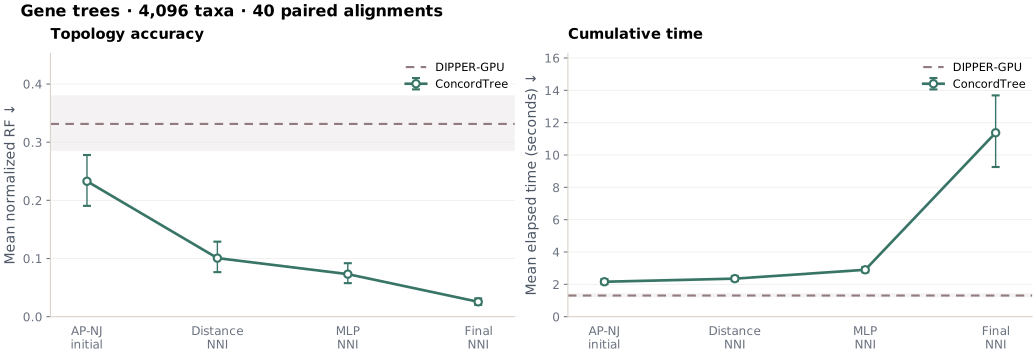
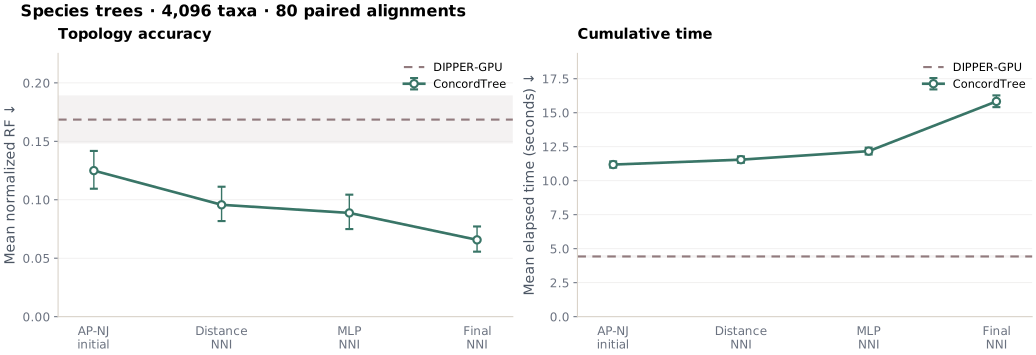
Stage-by-stage topology and time · 4,096 taxa
On each alignment we record the same run after the AP-NJ initial tree, distance NNI, MLP NNI and the task-specific final NNI. DIPPER-GPU is rerun on the same alignments. These are intermediate states of the sequential pipeline, not separate module-removal ablations. Lower nRF and lower time are better.
Gene trees · 40 alignments
| Stage or baseline | Mean nRF ↓ | Mean elapsed seconds ↓ |
|---|---|---|
| AP-NJ initial | 0.2328 | 2.16 |
| Distance NNI | 0.1007 | 2.35 |
| MLP NNI | 0.0731 | 2.90 |
| Likelihood NNI | 0.0255 | 11.38 |
| DIPPER-GPU | 0.3315 | 1.31 |
Species trees · 80 alignments
| Stage or baseline | Mean nRF ↓ | Mean elapsed seconds ↓ |
|---|---|---|
| AP-NJ initial | 0.1249 | 11.19 |
| Distance NNI | 0.0957 | 11.55 |
| MLP NNI | 0.0887 | 12.18 |
| Quartet-kernel NNI | 0.0657 | 15.83 |
| DIPPER-GPU | 0.1686 | 4.43 |
DIPPER gene-tree runs use automatic algorithm selection (-m 0), which selects conventional NJ at 4,096 taxa. Species-tree runs explicitly force k-closest placement (-m 1 -K 10); the reported species baseline is therefore not DIPPER's automatic 4,096-taxon mode. Both use JC distance (-d 2) and binary output (--force-binary).
ConcordTree times start before input preparation and accumulate to each stage; the final time includes output and branch support. DIPPER time includes PHYLIP-to-FASTA conversion and synchronized native file-to-tree work after CUDA/TBB warmup. Process and GPU startup are excluded. Measurements use one run per input, 16 CPU threads and two simultaneous L40S GPU workers; species records ran on GPU0/GPU1 in counts 24/56. The checkpoint observer adds small reads. Species ConcordTree uses the 100 observed locus boundaries, while DIPPER uses the concatenated alignment. Time boundaries and available input information therefore differ. All data have been used for development.
Gene parameter fitting did not satisfy the strict convergence criterion in 17 of 40 runs; all completed observations remain in the reported averages. Neither completed local search nor the convergence flag certifies a global optimum.
Gene-tree refinement
The V11 full-site likelihood implementation fits branch lengths and the requested reversible DNA model; this campaign fixes GTR+FO+I+G4. Felsenstein pruning evaluates likelihoods over all sites. Discrete rate categories account for among-site variation; FO optimizes nucleotide frequencies and I includes an invariant-site component.
Each NNI scan reuses the four surrounding cut messages and compares the current topology with its two local alternatives using approximate central-edge profiles. Conflict-free improving moves are applied and parameters/lengths are refitted. The release’s scientific stopping and numerical tolerances are unchanged. Local search and approximate local profiles provide no global maximum-likelihood certificate.
Species-tree refinement · observed loci
For each queried quartet, count the 15 nucleotide-equality pattern orbits separately in each observed locus. Remove the constant orbit, normalize the remaining counts per informative locus, take square roots, sum across loci, then normalize the resulting vector. This conditional Hellinger barycenter retains locus boundaries without estimating gene trees.
p[l, j] = c[l, j] / sum(j != constant, c[l, j])
x = normalize_L2(sum_l sqrt(p[l]))
k_G(x, z) = mean_g exp(-||x - g(z)||² / (2 h²))
s[t] = sum_m a[m] k_G(P[t] x, z[m])
Zero-information loci contribute zero. For the concatenated empirical inputs, the entire matrix is one unpartitioned block and the existing frozen MSA-only scorer asset is selected. The frozen scorer has 2,048 landmarks; the eight within-resolution quartet symmetries are averaged in the Gaussian kernel. Candidate permutations P[t] produce scores for the three resolutions. Landmarks, coefficients and bandwidth are loaded from the frozen observed-locus asset, not fitted to benchmark truth.
Nearest-24 panels define queried quartets; exact cached scores and stream-sum updates reuse evidence across local NNI candidates. The search tracks its cumulative objective and applies rule-A conflict selection with posterior stop ratio 0.005. The output contains species topology without estimated evolutionary branch lengths.
This is a finite learned kernel scorer, not a neural network or the old CASTER-polynomial objective. The finite conditional representation/scorer has known model counterexamples; it has no general MSC consistency theorem. CASTER is a related site-based comparator, and its theoretical guarantees are not inherited by this implementation.
Lightweight branch evidence
Gene trees. Let c0, c1, c2 be approximate conditional local-profile gains for the final split and its two NNI alternatives. Export 100 × softmax(c)[0]. Reuse the last valid scan; if the final tree/parameters invalidate it, the mandatory final verification may add one local NNI evaluation, without proposing moves or refitting parameters. A displayed 100 can result from a large conditional score gap and rounding.
Species trees. Remap cached unique quartets to final incident subtrees and average s(current) − max(s(alternative 1), s(alternative 2)) across informative quartets. The signed raw margin m is authoritative for ranking. Display 50 + 50m/(1+|m|). No informative quartets means missing evidence; it is never replaced with 0 or 100. The reducer needs one O(Q+N) pass and O(N) aggregate storage, in addition to the existing quartet cache.
No bootstrap alignments, repeated tree-inference runs, additional model fits or new species DNA/quartet predictions are required. A final gene verification scan can incur local scoring. Evidence is adaptive and correlated, so quartet counts are not independent sample sizes. Neither index is bootstrap, SH-aLRT, ASTRAL localPP or a calibrated probability.
Datasets and evaluation
Gene and species initialization both use K2P-gamma over all original columns and jointly observed sites. All 700 species simulations, ten concatenated empirical inputs, and seven original-locus appendix inputs were attempted anew on 8 November 2026. For the earlier benchmark summary, the 200 gene results are reused from the immediately preceding campaign; the 40 gene and 80 species alignments in the stage analysis were rerun for that analysis. Historical comparator accuracy measurements are retained. DIPPER GPU runtime was remeasured on all 900 simulated inputs with preinitialized CUDA/TBB and 16 CPU threads; other comparator runtimes remain archived measurements.
Gene: 200 existing AliSim DNA alignments, one generating tree per alignment. Five scales (256–4,096 taxa), 40 records per scale; multiple tree shapes and GTR/rate-variation settings, including indels in a subset. Original sequence lengths and source/truth hashes are frozen in the input inventory.
Species: The original SimPhy panel comprises small500 (32, 64, 128, 192, 256 taxa) and large200 (512, 1,024 taxa), with 50 ILS and 50 complex records per scale. A later large-scale panel adds 274 records at 2,048–4,096 taxa, including the 80 records in the stage analysis. Each contains 100 observed loci; complex simulations additionally include duplication/loss and horizontal transfer. DNA evolved along the locus histories using AliSim. In the topology results, Simple denotes the ILS family and Complex denotes the complex family. These conditions extend beyond an ideal independent pure-ILS MSC model.
Truth: generating trees for simulations; published study reference topologies for empirical comparisons. The latter are not biological truth. All pools have previously influenced development. No independent final generalization claim is made.
Statistics: 1,000 whole-alignment bootstrap samples for mean nRF and paired differences, seed 20261105. Support AUC intervals resample whole trees within scale/family strata. No branch-independent standard errors. Missing runs and partial comparator panels retain their original denominators; failures receive no invented RF or runtime.
Reproducibility: All 700 species simulations and all ten concatenated empirical inputs were attempted anew with K2P-gamma; the seven original-locus empirical appendix inputs were also rerun. The 200 gene measurements are reused with unchanged gene settings. Original input hashes were verified before inference. Historical comparator accuracy and available resource measurements remain archived; available historical trees were hash-checked, and missing historical input hashes remain explicitly absent. DIPPER GPU inference was rerun on all 900 simulated inputs to correct runtime boundaries. The reported DIPPER time includes format conversion and synchronized native file-to-tree work, excluding process/CUDA/TBB startup. It uses a preinitialized fresh CLI process per input rather than a retained session. New trees and independent RF checks are archived separately; historical accuracy is not replaced. Other comparator runtimes are unchanged. Per-method correct-branch length NMAE remains available. Current pair-specific same-branch length comparisons cannot be reconstructed where historical comparator trees were deleted; those old comparisons are archived separately and are not presented as current results.
References and method attribution
References identify reused principles, simulation software and related comparisons. Neighbor joining, projection-based candidate search and four-point NNI are established building blocks; DIPPER is a comparison baseline. The kernel expansion, cache/search choices and local evidence indices are implementation-specific components; no borrowed theorem is claimed for them.
Optimization diagnostics: 69 gene runs did not meet the strict parameter-convergence criterion; 0 runs have unconfirmed posterior-search convergence. These completed observations remain in the reported metrics. Completion does not certify a global optimum. Per-record quality flags.
Full JC / K2P-gamma comparison · Controlled warm timing comparison